
Updates on Corporate criminal liability of entities – Italian Legislative Decree No. 231/2001 (D. Lgs. 231/2001) Key developments, January-July 2026
By Avv. Flavia Betti Tonini, PhD
July 21, 2026
This blog concerns Italian law; the English terminology used herein is provided for convenience; the Italian statutory texts remain the sole authoritative sources.
We outline the most recent developments affecting Italian Legislative Decree No. 231 of June 8, 2001 (“D. Lgs. 231/2001”), which governs the administrative liability of companies and other entities arising from criminal offences committed in their interest or to their advantage.
In recent months, D. Lgs. 231/2001 has been the subject of a variety of legislative interventions: some have expanded the catalogue of predicate offences, while others indirectly affect risk areas and the updating of the Models required under D. Lgs. 231/2001. A comprehensive reform of the regime is also under consideration. (See the table below with a summary of the main developments).
EU restrictive measures (Art. 25-octies.2). This is the development with the greatest impact. For the first time, the pecuniary sanction may be calculated as a percentage of worldwide turnover (up to 5%), with an alternative cap of EUR 40 million, together with disqualification sanctions of up to six years. This does not concern multinationals alone: any undertaking engaging in trade with non-EU countries or with “designated” persons or entities is exposed.
Environmental offences (Art. 25-undecies). Implementing EU Directive 2024/1203, the catalogue of offences is broadened (trade in polluting products, ozone-depleting substances, and greenhouse gases), sanctions rise to as many as 1,200 quota units, and the offence of environmental pollution is reformulated, with new aggravating circumstances and protection extended to habitats.
Agri-food offences (Art. 25-bis.1) – attention to the scope. Italian Law No. 75/2026 rewrites the offences protecting Italian food products (“Made in Italy”), but for D. Lgs. 231/2001 purposes, the principal novelty concerns a single offence: the aggravated form of organized agri-food piracy (Italian Criminal Code, Art. 517-octies, fourth paragraph). Food fraud (Art. 517-sexies) and trade under false or misleading signs (Art. 517-septies) are relevant for the entity only where they take the continuous and structured form contemplated by that aggravating circumstance. This is a technical point on which the wording of the statute lends itself to misunderstanding.
Completing the picture are, on the one hand, the measure on trafficking in human beings, which amended Art. 25-quinquies of D. Lgs. 231/2001 entered into force on July 16, 2026; and, on the other, measures concerning labor and immigration which, while not necessarily introducing new predicate offences, may call for a review of procedures relating to HR, health and safety, and the management of foreign workers.
Artificial Intelligence: what is already in force and what lies ahead
Italian Law No. 132/2025, enacted last October, had already introduced aggravating circumstances for certain offences – including market rigging and market manipulation – where committed by means of artificial intelligence systems.
The draft implementing decrees, approved on June 10, 2026, further provide for a new offence of failure to adopt security measures in AI systems (Art. 437-bis of the Italian Criminal Code) and a new provision, designated Art. 25-vicies, concerning new categories of offences committed through the use of artificial intelligence tools (Art. 437-bis itself – not yet in force – and the unlawful dissemination of content generated or altered by artificial intelligence systems, Art. 612-quater of the Italian Criminal Code, introduced by Italian Law No. 132/2025).
The legislative process has not yet been completed, but it warrants close monitoring, as its impact may prove significant.
The reform project: the Fidelbo Working Group
In January 2026, the proposal for a comprehensive reform drawn up by the technical working group chaired by Giorgio Fidelbo was published. Its main lines are: organizational fault (colpa di organizzazione) becomes a constituent element of the offence, with the burden of proof resting on the prosecution even for offences committed by senior management; new forms of reward for cooperating entities; greater weight given to best practices in assessing the adequacy of the D. Lgs. 231/2001 Model; and strengthened procedural safeguards for the entity. Work in progress.
From the case law (Italian Corte di Cassazione, 2026)
– Judgment No. 143/2026 – where the public prosecutor has sufficient evidence, it is under a duty to charge the entity with the administrative offence: this is not a discretionary choice. And where the risk is connected with the continuation of the business activity, interim measures must be applied to the entity, not merely to the natural person.
– Judgment No. 8397/2026 – for the purpose of organizational fault, the absence or inadequacy of the D. Lgs. 231/2001 Model is not in itself sufficient: the prosecution must prove the causal link between the shortcomings and the offence that subsequently materialized. The “advantage” to the entity may consist even in mere savings of costs or time.
A summary of the main developments follows.
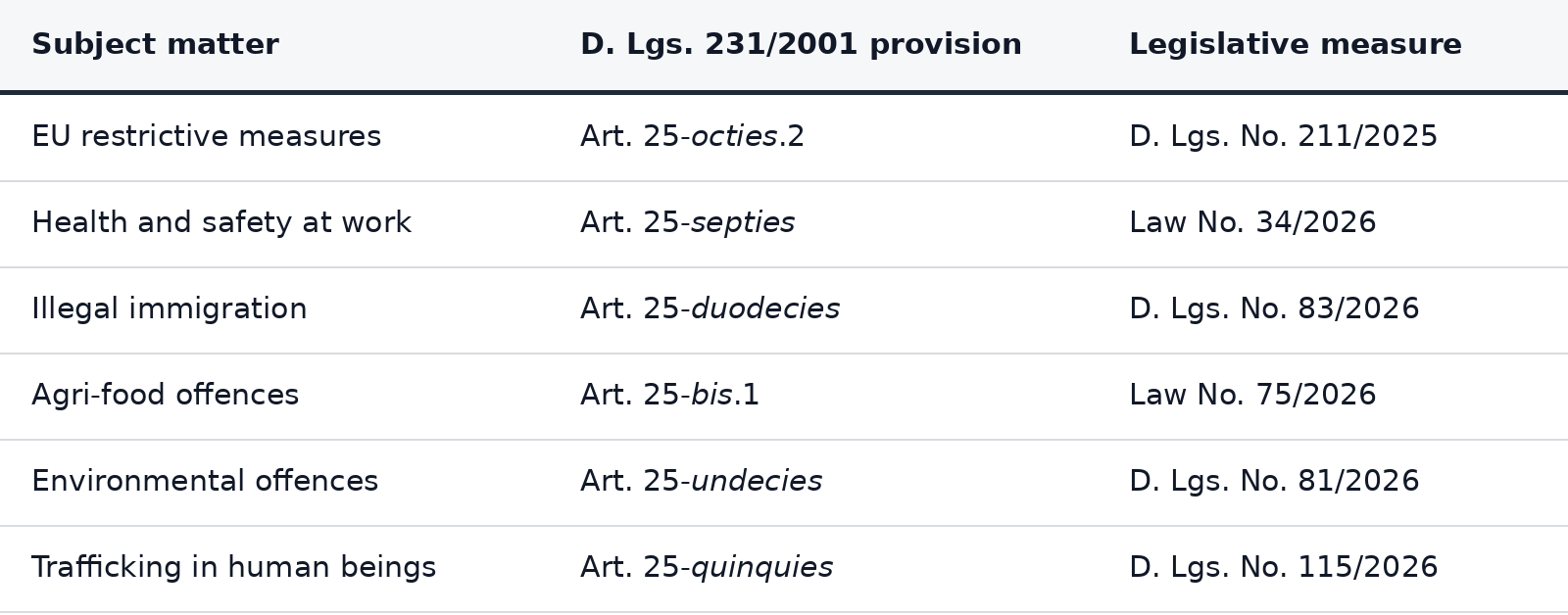
New measures affecting predicate offences and risk areas
Disclaimer: This publication is provided for general informational purposes only and does not constitute legal advice. Reading or relying on this material does not create an attorney-client relationship